The Changeling panic
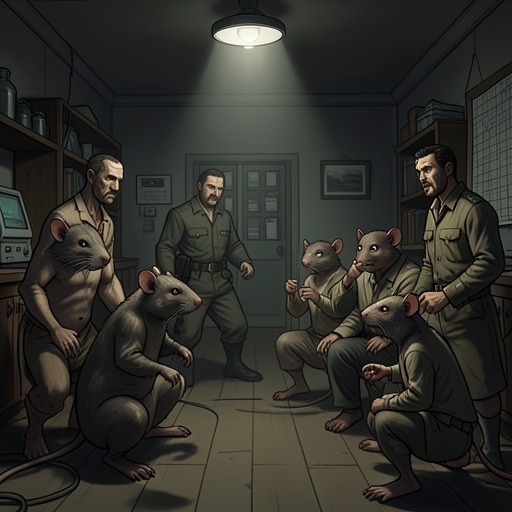
The Amazing Maurice and His Educated RodentsThe Changeling panic is the moment when the rats’ hard-won sense of themselves as thinking, speaking members of the Clan is overwhelmed by contagious fear. As the exploring party approaches a room filled with captive rats, terror passes through the tunnels faster than explanation can follow: rats bolt, speech gives way to squealing, and even experienced members lose their nerve. The scene turns the Clan’s defining achievement—thoughtful cooperation—into a fragile capacity that fear can abruptly erase.
Warning and Background
The panic throws an earlier effort to define the Clan into sharp relief. Dangerous Beans had argued that controlling fire could make a statement to the darkness: the rats were separate, not merely rats, but the Clan. Hamnpork distrusted the flame and worried that fire would bring trouble; Peaches, meanwhile, had heard that younger rats were frightened by shadows. These tensions establish that the Clan’s identity is not automatic. It has to be learned and asserted against inherited fear.
As Hamnpork’s exploration party is gone longer than expected, Peaches initially trusts Darktan’s caution: he checks every step. Then Dangerous Beans notices something wrong. A rat rushes down the tunnel, and he identifies what follows not by sight but by smell: fear. More frightened rats come after it. They do not stop to explain what they have found; their terror arrives ahead of them, carried through the tunnel by bodies in flight.
Fear Breaks Speech
The change is visible first in familiar individuals. Finest, whom Peaches expects to answer her, rushes past without speaking. Dangerous Beans recognizes that the rats are terrified, while Toxie is bitten as he tries to stop another runner. Peaches urges the others to go back and wonders whether a ferret is responsible. Toxie recalls that Hamnpork once killed a ferret, but that memory cannot steady the group as the stream of frightened rats continues.
The decisive loss is not simply that the rats run; it is that they seem to lose the capacity that distinguishes them as a community. More rats pour past, screeching and dodging Peaches. Dangerous Beans whispers that they have forgotten how to talk. Peaches recognizes Feedsfour, whom she had spoken to only an hour earlier, among the fleeing rats. The familiar face makes the collapse immediate: this is not an unknown mob behaving strangely, but members of their own society becoming unreachable to one another.
Toxie, too, is overtaken. His fur bristles, his eyes go unfocused, and he runs without responding to Peaches. She puts her paws around the crying Dangerous Beans as fear sweeps over them. The group’s earlier experience of danger had been different: during a remembered encounter with a dog, the rats had been frightened but still able to talk, set a trap, and watch Hamnpork drive it away. Now fear is not a challenge they can collectively reason through. It is dismantling the means by which they would do so.
The Room and the Retreat
The source of the terror is a long room crammed with rats. Cages fill it from floor to ceiling; bodies cling to the wire and netting, which strains under their weight. The air is dense with squeaking, rustling, and chittering. The surviving members of Hamnpork’s exploration party cluster in the middle, while many others have already fled. The scene’s scale matters: the explorers have not encountered a single frightened animal but a mass whose noise and smell exert pressure even on Maurice, who is not one of the rats.
When Keith breaks down the door, Maurice hears someone coming down a ladder and decides that the moment is no time to speak with humans. He spots a gap where a bar has rusted out of an old drain and darts through just as the rat-catchers enter the room. From the darkness, he watches the others retreat. Darktan tries to pull Hamnpork, who has frozen in place, toward safety. The others make for a drain on the opposite wall, moving unsteadily. Darktan finally gives up on Hamnpork; after drawing his sword and hesitating, he runs for the drain as well. The retreat leaves the human witnesses facing the rat-catchers and the captive population without the Clan’s most capable fighters beside them.
From Panic to Cooperation
The episode gains further weight from the contrast between a terrified mass and an organized community. Later, Maurice explains that rats used in rat-coursing were brought alive by rat-catchers and that, in a crowd, many rats could become a panicked mob rather than act as brave individuals. That distinction gives the cage-room scene a grim context: the captives’ confinement and shared terror are not incidental, but conditions that make a crowd vulnerable and manageable.
The Clan’s later response offers the counter-image. Darktan tells his squad that their strength lies in being rats with brains who can think and refuse to turn and run. When the Clan attacks the enemy rats, it advances in a line; the formation closes around attackers and then breaks into pairs to pursue fleeing opponents. The difference is not the absence of danger, but the presence of coordination. Against this later discipline, the cage-room panic marks the low point at which fear overwhelms speech, recognition, and mutual action. Its significance lies in showing that the Clan’s identity must be enacted together: shared intelligence can be lost in panic, but deliberate cooperation can restore the possibility of collective resistance.